
Dishwasher Troubleshooting
& Repair Guides
Find answers to common dishwasher problems, understand how your dishwasher works, and learn what may be causing draining, cleaning, filling, drying, leaking, and electrical issues. Explore troubleshooting guides, error codes, maintenance tips, and technical insights from appliance repair professionals.
Dishwasher Troubleshooting Topics
On This Page
- How a Dishwasher Works
- Water Fill System
- Circulation & Wash System
- Filters, Sump & Food Debris
- Spray Arms & Water Distribution
- Heating System
- Detergent & Dispenser System
- Drain System
- Door, Latch & Seal System
- Leak & Overflow Protection
- Drying System
- Electronic Control System
- Common Dishwasher Problems
- Understanding Error Codes
- Repair or Replace?
- Dishwasher Maintenance
- Troubleshooting Overview
Understanding Your Dishwasher: How It Works and Why Problems Occur
A dishwasher may seem simple from the outside: load the dishes, add detergent, select a cycle, and press Start. Inside the appliance, however, several water, mechanical, heating, drainage, and electronic systems must work together in a specific sequence.
The dishwasher needs to fill with the correct amount of water, circulate that water under pressure, distribute detergent, maintain the required temperature, remove food particles, drain dirty water, rinse the dishes, and help them dry before the cycle ends.
A problem with any one of these processes can affect the final result.
Understanding how a dishwasher operates can also make common symptoms easier to interpret. A dishwasher that fills with water but does not clean the dishes, for example, points toward a different group of possible problems than a machine that washes normally but leaves water standing in the bottom after the cycle.
This guide explains the major systems inside a household dishwasher, how they work together, and why common dishwasher problems develop.
How a Dishwasher Works
Although cycle designs vary between manufacturers and models, most dishwashers follow the same basic sequence:
Door locks → Water enters → Water is heated as needed → Circulation pump moves water through spray arms → Detergent is released → Dirty water drains → Fresh water enters for rinsing → Final drain → Drying stage begins
The dishwasher does not simply fill the entire tub with water.
Most modern machines use a relatively small amount of water and continuously recirculate it during each wash or rinse portion of the cycle.
The circulation pump sends water through the spray arms. The spray arms direct pressurized water across the dishes and then allow it to fall back into the bottom of the dishwasher, where it can be filtered and circulated again.
At specific points in the cycle, the drain system removes the used water and the dishwasher refills with fresh water.
The electronic control coordinates this entire process.
If one stage cannot be completed correctly, the dishwasher may stop, extend the cycle, display an error code, or continue operating while producing poor washing or drying results.
Let’s look at the major systems separately.
1. The Water Fill System
Every wash cycle requires the correct amount of water.
A typical water path looks approximately like this:
Household Water Supply → Supply Line → Water Inlet Valve → Dishwasher Tub
When the control requests water, the electrically operated inlet valve opens and allows household water pressure to push water into the dishwasher.
The amount of water entering the machine may be controlled by time, sensor feedback, a float system, or a combination of methods depending on the design.
Possible components include:
- water inlet valve
- supply hose or water line
- float
- float switch
- water-level sensor
- wiring
- electronic control
If the dishwasher receives too little water, the circulation system may not have enough water to wash effectively.
If water continues entering when it should stop, overfilling or leaking may occur.
What can prevent a dishwasher from filling?
Possible causes include:
- household water supply turned off
- kinked or restricted supply line
- failed water inlet valve
- clogged inlet screen
- float stuck in the raised position
- failed float switch
- door not properly latched
- wiring problem
- control fault
A dishwasher that does not fill therefore does not automatically have a failed inlet valve.
The control system may intentionally prevent filling if another required condition has not been satisfied.
Related guide: Dishwasher Not Filling With Water? Common Causes and What to Check →
2. The Circulation and Wash System
Once enough water is inside the tub, the dishwasher needs to move that water across the dishes with sufficient pressure.
This is the job of the circulation system.
A simplified wash-water path is:
Sump → Circulation Pump → Spray Arms → Dishes → Filters / Sump → Circulation Pump
The circulation pump draws water from the bottom of the dishwasher and forces it through one or more spray arms.
Small openings in the spray arms direct water toward different areas of the racks.
The force of the water also causes many spray arms to rotate.
Depending on the dishwasher, there may be:
- lower spray arm
- middle spray arm
- upper spray arm
- dedicated bottle jets
- additional wash zones
Modern dishwashers can use complex water-distribution systems that direct pressure toward different spray arms at different times.
What can reduce washing performance?
Common possibilities include:
- clogged spray-arm openings
- spray arm unable to rotate
- low water level
- weak or failed circulation pump
- blocked filter
- debris inside the sump
- improperly loaded dishes
- water-distribution problem
Poor cleaning does not automatically mean the dishwasher needs more detergent.
If water is not circulating correctly, adding detergent cannot compensate for inadequate spray pressure or blocked water paths.
Related guide: Dishwasher Not Cleaning Dishes? Common Causes and What to Check →
3. Filters, Sump and Food Debris
During washing, food particles and debris are carried back toward the bottom of the dishwasher.
The filtration system helps prevent that material from repeatedly being sprayed back onto the dishes or entering areas where it could interfere with pump operation.
Depending on the design, the dishwasher may use:
- removable filter
- fine filter screen
- coarse filter
- sump
- grinder or disposer system on some models
- pump screens
Some filters are designed to be removed and cleaned periodically.
Others are largely self-cleaning.
When a filter becomes heavily restricted, water circulation can suffer.
Possible symptoms include:
- poor cleaning
- food particles left on dishes
- cloudy wash water
- unpleasant odors
- unusual pump sounds
- longer or less effective wash cycles
Objects that fall into the sump can also create problems.
Broken glass, labels, bones, pieces of plastic, and other debris may obstruct water flow or contact moving pump components.
Before assuming that a circulation pump has failed, the accessible filter and sump areas should be considered.
4. Spray Arms and Water Distribution
Spray arms are responsible for directing wash water throughout the dishwasher.
Although they have no electrical connection on many designs, their operation is essential to cleaning performance.
Water pressure entering the spray arm creates the force needed for rotation.
If the spray arm cannot move freely, entire areas of the dishwasher may receive little or no effective washing action.
Common problems include:
- clogged spray holes
- cracked spray arm
- damaged bearing or support
- cookware physically blocking rotation
- incorrect rack position
- low circulation pressure
Loading is especially important.
A tall pan or utensil can prevent a spray arm from turning even though the dishwasher itself is functioning normally.
Likewise, dishes positioned too closely together can prevent water from reaching dirty surfaces.
The pattern of poor cleaning can provide useful clues.
If dishes on only the upper rack remain dirty, for example, the problem may be different from a dishwasher where cleaning performance is poor throughout both racks.
5. The Heating System
Hot water plays an important role in washing, sanitizing, and drying.
Depending on the model and selected cycle, the dishwasher may use an electric heating element or another heating design to increase or maintain water temperature.
The heating system can include:
- heating element
- temperature sensor or thermistor
- high-limit thermostat
- wiring
- control relay
- electronic control board
The dishwasher may pause or extend portions of the cycle while waiting for the water to reach the expected temperature.
A heating problem can therefore produce symptoms beyond simply “water isn’t hot.”
You may notice:
- poor cleaning
- detergent not dissolving properly
- unusually long cycle times
- poor drying
- temperature-related error codes
The household hot-water supply also matters.
If incoming water is unusually cold, the dishwasher may require additional time to reach the temperature expected for the selected cycle.
A heating complaint therefore needs to consider both the dishwasher’s heating system and the temperature of the water entering the appliance.
6. Detergent and Dispenser System
Dishwasher detergent needs to be released at the appropriate point in the cycle.
The dispenser is typically located inside the door and may contain separate areas for detergent and rinse aid.
Depending on the model, the dispenser assembly may include:
- detergent compartment
- dispenser door
- latch mechanism
- actuator
- rinse-aid reservoir
- electrical wax motor or solenoid
- wiring
The control releases the detergent after the initial portions of the cycle according to the selected program.
If the dispenser does not open, the dishwasher may complete the cycle while leaving dishes poorly cleaned.
However, detergent remaining in the dispenser does not automatically mean the dispenser itself has failed.
Possible reasons include:
- cookware blocking the dispenser door
- dispenser mechanism stuck
- detergent hardened by moisture
- insufficient water circulation
- cycle interrupted
- control or wiring problem
Detergent type and quantity also matter.
Using more detergent than necessary can leave residue without improving cleaning performance.
The correct amount depends on the detergent, dishwasher design, water hardness, soil level, and cycle being used.
7. The Drain System
After each wash or rinse stage, dirty water must leave the dishwasher.
A typical drainage path looks like this:
Sump → Drain Pump → Drain Hose → Sink Drain / Garbage Disposal
The drain pump pushes water out of the machine through the drain hose.
Depending on the installation, that hose may connect to a garbage disposal, sink drain, or dedicated plumbing connection.
The installation of the drain hose is important because it helps prevent dirty sink water from flowing back toward the dishwasher.
Common drainage problems include:
- clogged filter or sump
- debris inside the drain pump
- failed drain pump
- kinked drain hose
- blocked drain hose
- clogged sink connection
- garbage disposal connection blocked
- improper drain-hose installation
- wiring or control problem
Standing water in the dishwasher does not always mean the drain pump has failed.
The pump may be operating normally while a restriction farther downstream prevents water from leaving.
Listening to what happens during the drain portion of the cycle can provide useful information.
A humming pump with little or no water movement suggests a different problem from a pump that never attempts to run.
Related guide: Dishwasher Not Draining? Common Causes and What to Check →
8. Door, Latch and Seal System
The dishwasher door has two important jobs.
It must keep water inside the tub and confirm that the appliance is safe to operate.
The system may include:
- door latch
- door switch
- door gasket
- lower door seal
- hinges
- springs or cables
- wiring
Before starting certain functions, the control needs confirmation that the door is properly closed.
If the latch or switch does not provide the expected signal, the dishwasher may appear completely normal until Start is pressed — and then fail to begin the cycle.
The sealing system works differently.
The door gasket helps contain water while the circulation pump sprays water throughout the tub.
A leak around the door can result from a damaged seal, but the gasket is not always the original cause.
Excessive suds, incorrect loading, spray-arm damage, or a dishwasher that is not level can direct water toward areas of the door where leakage occurs.
This is why replacing a door gasket based only on the location of water is not always reliable.
Related guide: Dishwasher Won’t Start? Door Latch, Power and Other Common Causes →
9. Leak Detection and Overflow Protection
Many modern dishwashers include systems designed to detect or prevent excessive water.
A traditional design may use a float inside the tub.
As the water level rises, the float moves upward and can activate a switch that tells the control to stop filling.
Other dishwashers use electronic water-level or leak-detection systems.
Some models have a base pan beneath the tub with a sensor or float designed to detect water that has leaked into the bottom of the appliance.
When a leak is detected, the dishwasher may:
- stop the cycle
- prevent additional filling
- run the drain pump continuously
- display an error code
This behavior can be confusing because the dishwasher may appear to have a drain or control problem when it is actually responding to water detected in the base.
Finding the source of the leak is more important than simply resetting the error.
10. The Drying System
Once washing and rinsing are complete, the dishwasher needs to remove moisture from the dishes.
Dishwashers use several different drying methods.
Depending on the model, drying may involve:
- exposed heating element
- condensation drying
- heated final rinse
- ventilation fan
- automatic door opening
- rinse aid
- combinations of these methods
Traditional heated-dry systems use an electric heating element to increase the temperature inside the tub.
Other dishwashers rely heavily on residual heat and condensation.
During condensation drying, moisture evaporates from hot dishes and condenses on cooler stainless-steel surfaces inside the dishwasher.
This difference is important because not every dishwasher is designed to make plastic items completely dry.
Plastic retains less heat than ceramic, glass, or metal and often remains wetter at the end of the cycle.
What can reduce drying performance?
Possible causes include:
- rinse aid empty or disabled
- heating problem
- incorrect cycle selection
- poor loading
- water not hot enough
- vent or fan problem
- dishes unloaded too soon
Drying performance should therefore be evaluated according to the drying technology used by the specific dishwasher.
Related guide: Dishwasher Not Drying Dishes? Common Causes Explained →
11. The Electronic Control System
Modern dishwashers rely on electronic controls to coordinate the entire wash cycle.
The main control may communicate with or operate components such as:
- water inlet valve
- circulation pump
- drain pump
- heating system
- detergent dispenser
- door latch
- temperature sensor
- water-level sensor
- leak sensor
- vent fan
- user interface
A simplified sequence might look like this:
Start Selected → Door Verified → Fill → Circulate → Heat → Drain → Rinse → Final Drain → Dry
At each stage, the control may expect feedback from one or more sensors.
If the expected condition does not occur, the dishwasher may pause, stop, extend the cycle, or display an error code.
This is why an inactive component is not automatically a failed component.
A circulation pump that does not run, for example, could have failed electrically or mechanically — but the control may also be withholding power because another required condition has not been met.
Accurate diagnosis requires understanding both the component and the sequence controlling it.
How Common Dishwasher Problems Develop
Dishwasher problems become easier to understand when the appliance is viewed as a sequence of connected processes.
The machine must:
- confirm that the door is closed
- receive the correct amount of water
- circulate that water effectively
- release detergent
- maintain appropriate temperature
- filter food debris
- drain used water
- rinse with fresh water
- complete the drying process
A failure early in the sequence can create symptoms later in the cycle.
For example, too little water can produce poor cleaning even though the circulation pump is functioning.
A drainage problem can leave dirty water behind and make dishes appear poorly washed.
A heating problem can affect cleaning, cycle time, and drying at the same time.
Understanding which part of the cycle is not occurring normally is therefore one of the most useful troubleshooting clues.
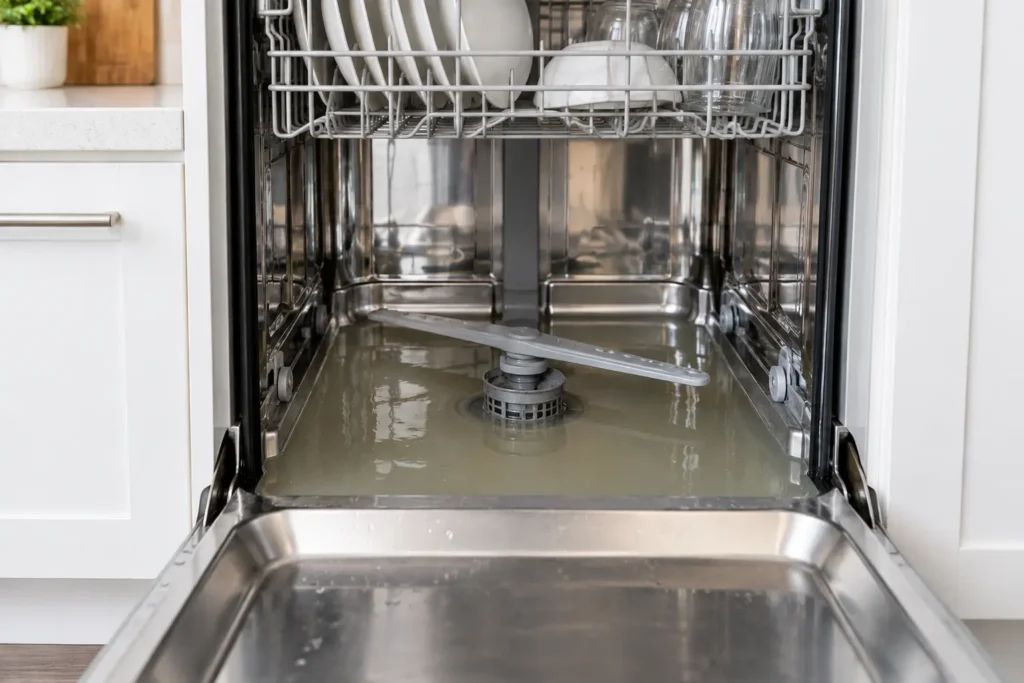
Dishwasher Not Draining
A dishwasher that leaves water in the bottom after the cycle has a problem somewhere in the drainage process.
The amount of water matters.
A small amount of water in certain sump areas can be normal depending on the dishwasher design.
A visible pool covering the bottom of the tub is different.
Possible causes include:
- clogged filter
- debris in the sump
- blocked drain pump
- failed drain pump
- kinked drain hose
- clogged drain hose
- blocked garbage disposal connection
- plumbing restriction
- wiring or control problem
The first useful question is whether the drain pump attempts to run.
If the pump can be heard but water does not leave, a mechanical blockage or downstream restriction becomes more significant.
If the pump remains completely silent when drainage should occur, electrical testing may be required.
Detailed troubleshooting: Dishwasher Not Draining? Common Causes and What to Check →
Dishwasher Not Cleaning Dishes
Poor cleaning can have many causes because successful washing depends on water volume, pressure, temperature, detergent, filtration, and loading.
Possible problem areas include:
- low water level
- clogged spray arms
- circulation pump
- dirty filter
- blocked sump
- incorrect loading
- low water temperature
- detergent problem
- water-distribution system
The pattern of dirty dishes can help.
Poor cleaning throughout the dishwasher suggests a different problem from poor cleaning limited to one rack or one side.
Food residue can also provide clues.
If detergent remains largely untouched in the dispenser, the issue may involve dispenser operation or inadequate water circulation.
If dishes are covered with redeposited debris, filtration and water quality may become more significant.
Before replacing components, basic loading, filter condition, and spray-arm movement should be checked.
Detailed troubleshooting: Dishwasher Not Cleaning Dishes? Common Causes Explained →
Dishwasher Not Filling With Water
A dishwasher that starts but receives little or no water may have a problem with the fill system or with another condition required before filling is allowed.
Possible causes include:
- closed water supply
- restricted supply line
- failed inlet valve
- float or float switch problem
- water-level sensor issue
- door latch problem
- control fault
- wiring problem
Listening during the beginning of the cycle can help.
Some dishwashers briefly run the drain pump before filling, which is normal.
The important question is what happens afterward.
If the inlet valve is energized but water flow is weak, the supply path or valve may be restricted.
If the dishwasher never attempts to fill, the diagnostic path may involve the door system, controls, or electrical circuit.
Related guide: Dishwasher Not Filling With Water? What to Check First →
Dishwasher Is Leaking
A dishwasher can leak from several different systems.
Possible sources include:
- water supply connection
- inlet valve
- internal hoses
- circulation pump
- drain pump
- door gasket
- lower door area
- tub
- dispenser
- drain hose
The timing of the leak is especially useful.
Leak during filling may point toward the supply line, inlet valve, or fill system.
Leak during washing can involve circulation components, internal hoses, excessive suds, or the door area.
Leak during draining makes the drain pump and drain hose more significant.
Water visible near the front of the dishwasher does not automatically mean the door gasket has failed.
Water can travel along the frame or base before reaching the floor.
Finding where the leak begins is more reliable than replacing the component closest to where the water becomes visible.
Related guide: Dishwasher Leaking Water? Common Sources and What to Check →
Dishwasher Not Drying Dishes
Wet dishes at the end of a cycle do not always indicate a failed heater.
Drying performance depends heavily on dishwasher design.
Possible factors include:
- rinse aid not being used
- selected cycle
- water temperature
- heating system
- vent or drying fan
- loading
- type of dishes
Plastic containers commonly retain more moisture than glass or ceramic items.
Water can also collect in recessed areas on cups and containers regardless of how well the drying system operates.
If drying performance suddenly becomes significantly worse than it was previously, however, the heating, rinse-aid, ventilation, or control systems may need attention.
The key is comparing current performance with what is normal for that specific dishwasher.
Detailed troubleshooting: Dishwasher Not Drying? Common Causes and What to Check →
Dishwasher Won't Start
A dishwasher may have power and still refuse to begin a wash cycle.
The display may illuminate and buttons may respond normally.
Possible causes include:
- door not fully closed
- failed door latch
- door switch problem
- control lock enabled
- delayed-start setting
- electrical supply issue
- user-interface problem
- main control fault
- wiring problem
The door-latch signal is especially important.
If the control cannot confirm that the door is closed, it may prevent pumps, valves, and heating components from operating.
Some models may appear completely inactive, while others display a specific error or indicator.
Before assuming the main control board has failed, door operation, settings, and power supply should be checked.
Related guide: Dishwasher Won’t Start? Common Causes and What to Check →
Dishwasher Is Making Noise
Dishwashers normally produce a variety of sounds.
Water enters the machine, spray arms rotate, pumps operate, valves open, and water moves through the drain hose.
Some humming, swishing, clicking, and water noise is therefore normal.
A new or unusually loud sound can provide useful diagnostic information.
Possible sources include:
- circulation pump
- drain pump
- spray arm contacting dishes
- debris inside pump area
- water inlet valve
- loose components
The point in the cycle when the sound occurs matters.
Noise only during draining points toward a different group of components than noise occurring throughout the wash portion.
A repetitive knocking sound may simply be a spray arm striking a utensil or dish.
Grinding or unusually loud pump noise may indicate debris or mechanical wear.
Related guide: Dishwasher Making Noise? What Different Sounds May Mean →
Dishwasher Cycle Takes Too Long
Modern dishwasher cycles can be considerably longer than many users expect.
High-efficiency machines often reduce water and energy consumption by extending wash time.
A long cycle is therefore not automatically a malfunction.
However, a significant change from the dishwasher’s normal cycle duration can indicate a problem.
Possible causes include:
- incoming water too cold
- heating system problem
- temperature sensor issue
- excessive soil detected by a sensor
- repeated filling or draining
- control problem
If the dishwasher is waiting for the water to reach a target temperature, a heating problem may cause the control to extend the cycle substantially.
Comparing current cycle duration with the machine’s previous normal behavior is more useful than comparing it with a different dishwasher model.
Understanding Dishwasher Error Codes
Modern dishwashers monitor many parts of the wash process.
When the control detects an unexpected condition, it may display an error or fault code.
Depending on the manufacturer, codes may relate to:
- water supply
- drainage
- heating
- temperature sensing
- circulation pump
- leak detection
- water level
- door latch
- communication between electronic components
An error code can significantly narrow the diagnostic path.
It does not always identify the failed component.
A drain-related error, for example, may be caused by a failed drain pump, but it could also result from a clogged filter, blocked hose, plumbing restriction, wiring issue, or control problem.
A leak code may indicate water in the base of the dishwasher without revealing where that water came from.
Error codes should therefore be treated as diagnostic clues rather than automatic instructions to replace a specific part.
Repair or Replace Your Dishwasher?
Whether a dishwasher should be repaired or replaced depends on more than its age.
Important factors include:
- dishwasher age
- overall condition
- type of failure
- repair cost
- previous repair history
- replacement-part availability
- condition of racks and tub
- cost of a comparable replacement appliance
Many common problems involve replaceable components such as pumps, valves, latches, sensors, dispensers, or heating components.
A relatively straightforward drainage or fill problem may make repair worthwhile even on an older machine.
Multiple major failures, structural damage, unavailable parts, or repeated expensive repairs can change the calculation.
An accurate diagnosis should come before the decision.
A dishwasher that will not drain could have a simple blockage or a failed pump. A dishwasher that does not clean properly may need a repair — or it may have a loading, filtration, or water-temperature problem that requires no major component replacement.
Knowing the actual cause makes the repair-versus-replacement decision much more meaningful.
Basic Dishwasher Maintenance Can Prevent Many Problems
A few routine habits can help maintain cleaning performance and prevent avoidable drainage, odor, and circulation problems.
Remove large food scraps and non-food objects before loading dishes.
Check and clean the dishwasher filter when required by the manufacturer’s instructions.
Inspect spray-arm openings periodically and make sure the arms can rotate freely.
Load dishes so that large items do not block spray arms or the detergent dispenser.
Use dishwasher detergent in the appropriate amount and use rinse aid when recommended.
Make sure the household hot-water system provides appropriate incoming water temperature.
Periodically inspect the area beneath and around the dishwasher for signs of moisture.
If the dishwasher connects to a garbage disposal, remember that plumbing restrictions can affect dishwasher drainage even when the appliance itself is operating normally.
Pay attention to changes in normal behavior.
New pump noises, standing water, declining cleaning performance, repeated error codes, unusually long cycles, or moisture around the appliance can be early signs of a developing problem.
Understanding the System Makes Dishwasher Troubleshooting Easier
A dishwasher becomes easier to diagnose when the wash cycle is viewed as a sequence of connected systems.
The fill system brings water into the machine.
The circulation system moves that water through the spray arms.
The filtration system manages food debris.
The heating system supports washing and drying.
The drain system removes used water.
The door and latch system keeps water inside and allows safe operation.
The drying system helps remove moisture after the final rinse.
And the electronic controls coordinate the entire sequence.
When a dishwasher develops a problem, identifying the stage where normal operation changes can often narrow the diagnosis considerably.
Does the dishwasher fill?
Can you hear water circulating?
Are the spray arms moving?
Does the water drain?
Does the machine heat?
Does the cycle complete normally?
Those observations can help separate basic loading, filtration, installation, or plumbing issues from failures that require electrical testing, component-level diagnosis, or professional service.
On This Page
- How a Dishwasher Works
- Water Fill System
- Circulation & Wash System
- Filters, Sump & Food Debris
- Spray Arms & Water Distribution
- Heating System
- Detergent & Dispenser System
- Drain System
- Door, Latch & Seal System
- Leak & Overflow Protection
- Drying System
- Electronic Control System
- Common Dishwasher Problems
- Understanding Error Codes
- Repair or Replace?
- Dishwasher Maintenance
- Troubleshooting Overview
Dishwasher Repair Throughout the Denver Metro Area
Need Professional Dishwasher Repair?
If your dishwasher isn’t cleaning properly, won’t drain, is leaking, or stops during a cycle, the problem may require professional diagnostics.
Mint Appliance Repair provides professional dishwasher diagnosis and repair throughout the Denver metro area.
Same-day appointments
Upfront pricing
90-day warranty on parts and labor
Denver metro experts
BROWSE APPLIANCE REPAIR GUIDES
REFRIGERATOR
Cooling problems, ice makers, compressors, defrost systems & error codes
WASHER
Drainage, spinning, leaks, vibration & electronic faults
DRYER
Heating problems, airflow, thermostats, belts & sensors
OVEN & RANGE
Heating elements, igniters, temperature issues & control boards
DISHWASHER
Drainage, cleaning, leaks, pumps & heating problems
ERROR CODES
Error codes, fault codes & diagnostic information
APPLIANCE ERROR CODES & DIAGNOSTICS

TROUBLESHOOTING BY PROBLEM
- Refrigerator Not Cooling
- Dishwasher Not Draining
- Washer Won’t Drain
- Appliance Making Noise
- Dryer Not Heating
- Appliance Leaking Water
- Oven Not Heating
- Appliance Won’t Turn On
FEATURED REPAIR GUIDES
Why Is My Refrigerator Not Cooling?
Common causes include dirty condenser coils, failed fans, defrost problems, sensors, and sealed-system failures.
Why Won’t My Washer Drain?
Learn what causes drainage issues and how to diagnose pumps, hoses, and filters.
Why Is My Dryer Not Heating?
Find out the most common reasons why your dryer doesn’t heat and how to fix them.
Oven Not Heating? Top 6 Causes
From bad igniters to control boards—here’s how to identify the problem.